

How Have Changes In Eastern Europe Altered The Enthic Makeup Of European. Countries Answers
The Iron Curtain that once divided Europe may be long gone, just the continent today is split by stark differences in public attitudes toward religion, minorities and social bug such as gay union and legal ballgame. Compared with Western Europeans, fewer Central and Eastern Europeans would welcome Muslims or Jews into their families or neighborhoods, extend the correct of marriage to gay or lesbian couples or augment the definition of national identity to include people born outside their country.
These differences emerge from a series of surveys conducted by Pew Inquiry Eye between 2015 and 2017 among nearly 56,000 adults (ages xviii and older) in 34 Western, Central and Eastern European countries, and they continue to divide the continent more a decade after the European Spousal relationship began to expand well beyond its Western European roots to include, amongst others, the Primal European countries of Poland and Hungary, and the Baltic states of Estonia, Latvia and Lithuania.
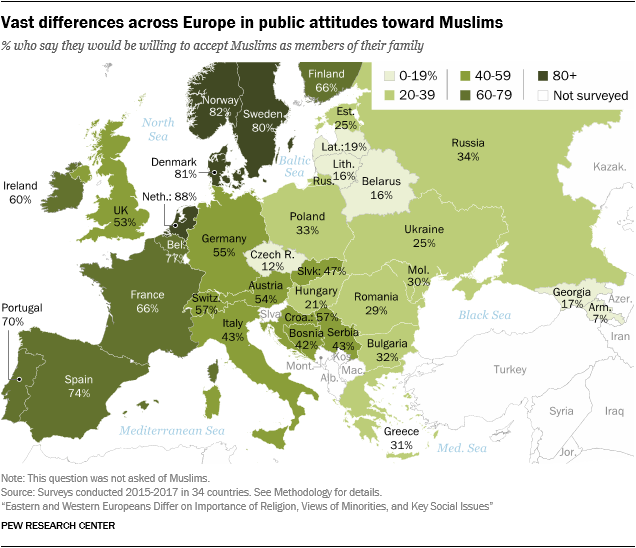
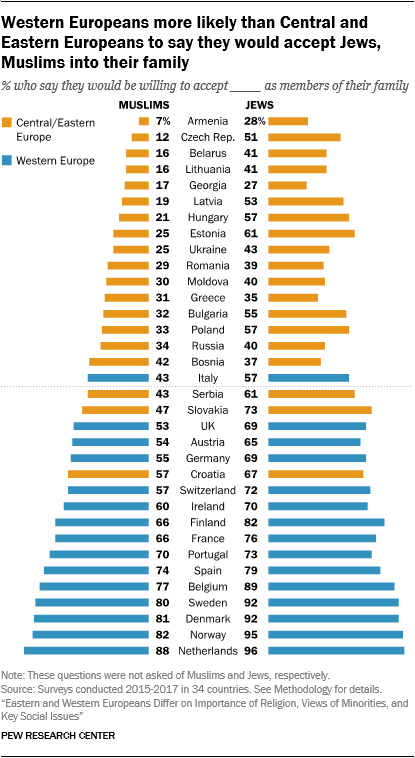 The continental dissever in attitudes and values can be extreme in some cases. For instance, in virtually every Central and Eastern European country polled, fewer than half of adults say they would be willing to accept Muslims into their family unit; in nearly every Western European country surveyed, more than than half say they would have a Muslim into their family unit. A similar divide emerges between Primal/Eastern Europe and Western Europe with regard to accepting Jews into one'southward family.
In a split up question, Western Europeans also are much more probable than their Central and Eastern European counterparts to say they would accept Muslims in their neighborhoods.i For example, 83% of Finns say they would be willing to have Muslims every bit neighbors, compared with 55% of Ukrainians. And although the split up is less stark, Western Europeans are more likely to express acceptance toward Jews in their neighborhoods likewise.
Defining the boundaries of Eastern and Western Europe
The definition and boundaries of Central, Eastern and Western Europe can be debated. No thing where the lines are drawn, nonetheless, there are strong geographic patterns in how people view religion, national identity, minorities and key social issues. Particularly sharp differences emerge when comparing attitudes in countries historically associated with Eastern vs. Western Europe.
In countries that are centrally located on the continent, prevailing attitudes may marshal with pop opinions in the Due east on some problems, while more than closely reflecting Western public sentiment on other matters. For example, Czechs are highly secular, generally favor same-sex marriage and do non acquaintance Christianity with their national identity, similar to most Western Europeans. Merely Czechs also limited low levels of acceptance toward Muslims, more closely resembling their neighbors in the Eastward. And nigh Hungarians say that beingness born in their country and having Hungarian ancestry are important to being truly Hungarian – a typically Eastern European view of national identity. Yet, at the same time, only about six-in-x Hungarians believe in God, reflecting Western European levels of conventionalities.
In another cases, Central European countries fall between the East and the Westward. Roughly half of Slovaks, for case, say they favor same-sex marriage, and a similar share say they would take Muslims in their family unit – lower shares than in almost Western European countries, but well above their neighbors in the E. And still others simply lean toward the Eastward on virtually issues, every bit Poland does on views of national identity and Muslims, also as same-sex marriage and abortion.
Researchers included Poland, the Czech Commonwealth, Slovakia, Republic of hungary, the Baltics and the Balkans equally part of "Central and Eastern Europe" because all these countries were part of the Soviet sphere of influence in the 20th century. Although Greece was not part of the Eastern bloc, it is categorized in Central and Eastern Europe because of both its geographical location and its public attitudes, which are more than in line with Eastern than Western Europe on the issues covered in this report. For example, virtually Greeks say they are not willing to accept Muslims in their families; three-quarters consider being Orthodox Christian of import to existence truly Greek; and nearly nine-in-ten say Greek culture is superior to others. Due east Germany is another unusual case; it was part of the Eastern bloc, simply is now included in Western Europe as part of a reunified Germany.
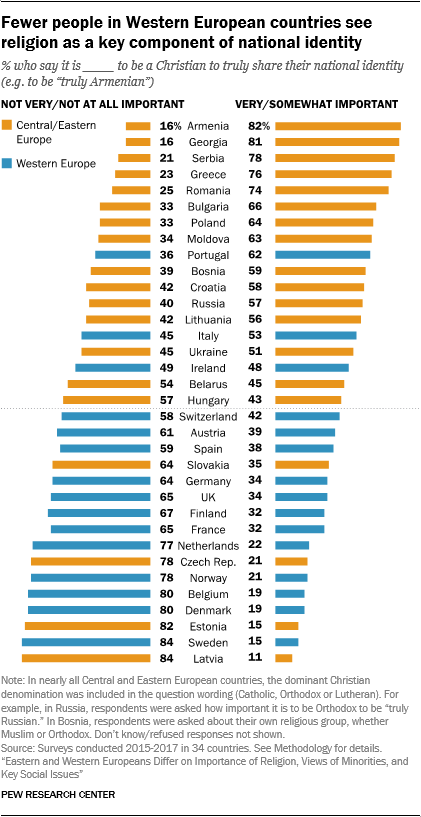
Attitudes toward religious minorities in the region get mitt in hand with differing conceptions of national identity. When they were in the Soviet Union's sphere of influence, many Key and Eastern European countries officially kept religion out of public life. But today, for most people living in the quondam Eastern bloc, beingness Christian (whether Catholic or Orthodox) is an important component of their national identity.
In Western Europe, by contrast, almost people don't experience that religion is a major part of their national identity. In France and the United kingdom, for case, nigh say it is not important to exist Christian to be truly French or truly British.
To be sure, not every country in Europe neatly falls into this design. For example, in the Baltic states of Latvia and Estonia, the vast majority of people say being Christian (specifically Lutheran) is non important to their national identity. Still, relatively few express willingness to accept Muslims equally family unit members or neighbors.
But a general E-West design is likewise credible on at least 1 other measure out of nationalism: cultural chauvinism. The surveys asked respondents across the continent whether they concord with the statement, "Our people are non perfect, but our culture is superior to others." While there are exceptions, Central and Eastern Europeans overall are more inclined to say their culture is superior. The eight countries where this attitude is nigh prevalent are all geographically in the East: Greece, Georgia, Armenia, Bulgaria, Russia, Bosnia, Romania and Serbia.
People in Key and Eastern Europe too are more than likely than Western Europeans to say being born in their land and having family background there are of import to truly share the national identity (e.g., to be truly Romanaian; see here.).
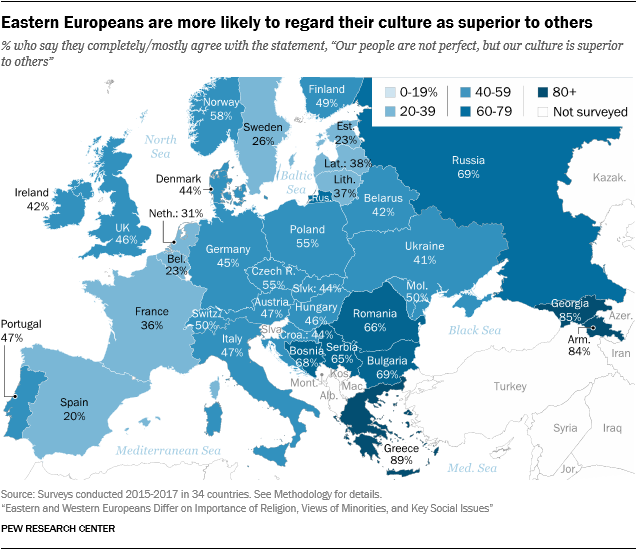
Taken together, these and other questions well-nigh national identity, religious minorities and cultural superiority would seem to point a European divide, with loftier levels of religious nationalism in the E and more openness toward multiculturalism in the West. Other questions asked on the survey bespeak to a further Due east-Due west "values gap" with respect to key social issues, such as aforementioned-sex wedlock and legal ballgame.
Differences over the meaning of 'European values'
Is Christianity a "European value?" What near secularism? And how about multiculturalism and open borders?
Leaders ofttimes cite European values when defending their stances on highly charged political topics. Just the term "European values" tin mean different things to unlike people. For some, it conjures up the continent's Christian heritage; for others, it connotes a broader political liberalism that encompasses a separation between church building and country, aviary for refugees, and democratic government.
For the Eu, whose members include 24 of the 34 countries surveyed in this study, the term "European values" tends to signify what Americans might consider liberal ethics.two The "Charter of Central Rights of the European Matrimony" includes respect for cultural and religious diversity; prohibitions confronting discrimination based on religion and sexual orientation; the right to asylum for refugees; and guarantees of freedom of movement within the Eu.3
These rights and principles are part of the EU's legal system and have been affirmed in decisions of the European Court of Justice going back decades.4 Merely the membership of the EU has changed in recent years, start in 2004 to spread significantly from its celebrated western base into Central and Eastern Europe. Since that year, Bulgaria, Croatia, Cyprus, the Czech Republic, Estonia, Hungary, Latvia, Lithuania, Malta, Poland, Romania, Slovakia and Slovenia have joined the EU. In many of these countries, the surveys show that people are less receptive to religious and cultural pluralism than they are in Western Europe – challenging the notion of universal assent to a set of European values.
These are not the only problems dividing Eastern and Western Europe.five But they have been in the news since a surge in immigration to Europe brought tape levels of refugees from predominantly Muslim countries and sparked tearing debates amongst European leaders and policymakers near border policies and national values.
Hungarian Prime number Minister Viktor Orbán has articulated one strain of opposition to the EU's conception of European values, declaring in July 2018 that "Key Europe … has a special culture. It is different from Western Europe." Every European country, he said, "has the right to defend its Christian culture, and the right to reject the ideology of multiculturalism," as well equally the right to "reject clearing" and to "defend the traditional family model." Earlier in the year, in an address to the Hungarian parliament, he criticized the Eu opinion on migration: "In Brussels at present, thousands of paid activists, bureaucrats and politicians work in the direction that migration should exist considered a human right. … That's why they want to take away from u.s.a. the correct to decide with whom we want to live."
This is non to propose that support for multiculturalism is universal even in Western Europe. Substantial shares of the public in many Western European countries view being Christian as a cardinal component of their national identity and say they would not take Muslims or Jews every bit relatives. And of form, the United Kingdom voted in 2016 to leave the European Spousal relationship, which many have suggested came in role due to concerns almost immigration and open borders. But on the whole, people in Western European countries are much more than likely than their neighbors in the E to embrace multiculturalism.
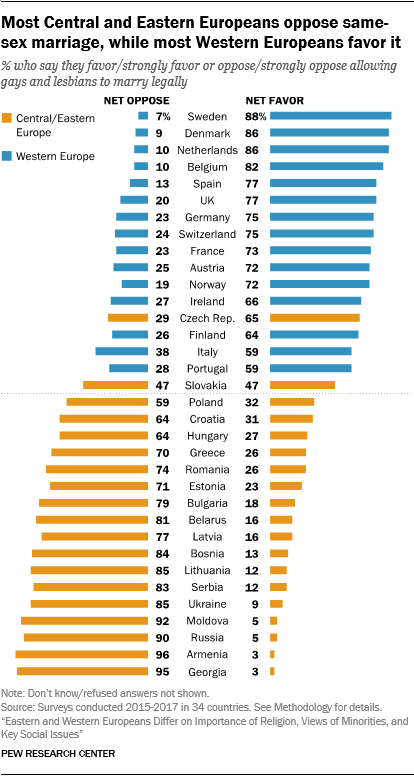 Majorities favor same-sex spousal relationship in every Western European country surveyed, and almost all of these countries have legalized the exercise. Public sentiment is very different in Central and Eastern Europe, where majorities in well-nigh all countries surveyed oppose allowing gays and lesbians to marry legally. None of the Fundamental and Eastern European countries surveyed allow aforementioned-sex marriages.
In some cases, these views are near universally held. Fully 9-in-ten Russians, for instance, oppose legal same-sex marriage, while similarly lopsided majorities in the netherlands, Denmark and Sweden favor allowing gay and lesbian couples to marry legally.
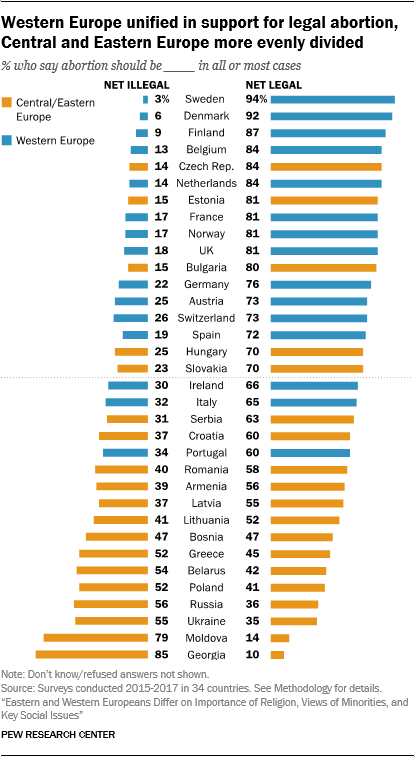 Even though abortion generally is legal in both Cardinal/Eastern and Western Europe, in that location are regional differences in views on this topic, too.6 In every Western European nation surveyed – including the heavily Catholic countries of Ireland, Italia and Portugal – six-in-ten or more adults say abortion should exist legal in all or most cases.
Only in the Eastward, views are more than varied. To be sure, some Central and Eastern European countries, such as the Czech republic, Republic of estonia and Bulgaria, overwhelmingly favor legal abortion. But in several others, including Poland, Russia and Ukraine, the residual of opinion tilts in the other management, with respondents more than probable to say that ballgame should be mostly or entirely illegal.
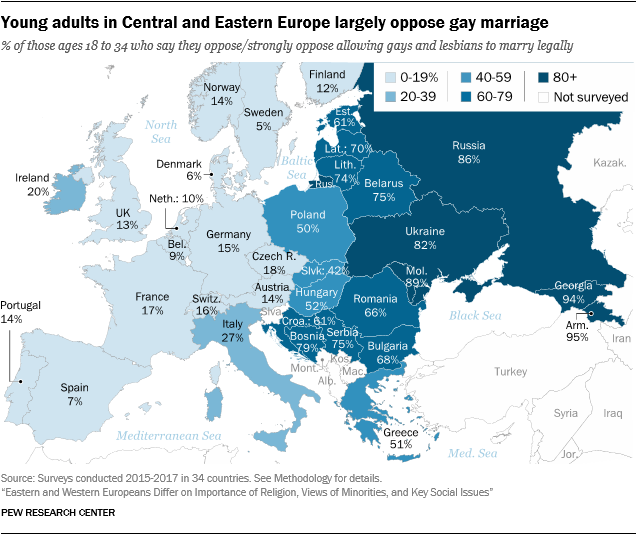
Survey results suggest that Europe's regional divide over same-sex marriage could persist into the hereafter: Across about of Central and Eastern Europe, young adults oppose legalizing gay wedlock by only somewhat narrower margins than do their elders.
For example, 61% of younger Estonians (ages 18 to 34) oppose legal gay marriage in their country, compared with 75% of those 35 and older. By this mensurate, immature Estonian adults are nonetheless six times as likely as older adults in Kingdom of denmark (x%) to oppose aforementioned-sex matrimony. This design holds across the region; young adults in nearly every Cardinal and Eastern European country are much more conservative on this issue compared with both younger and older Western Europeans.
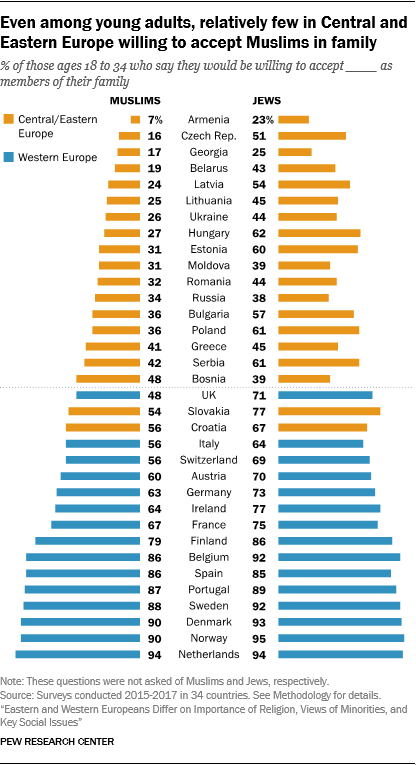 In addition, when it comes to views almost Muslims and Jews, immature adults in nearly countries in Fundamental and Eastern Europe are no more accepting than their elders.
Consequently, those in this younger generation in Central and Eastern Europe are much less likely than their peers in Western Europe to express openness to having Muslims or Jews in their families. For example, 36% of Polish adults under 35 say they would be willing to take Muslims in their family, far below the two-thirds of young French adults who say they would be willing to take Muslims in their family – mirroring the overall publics in those countries.
These are among the findings of Pew Research Center surveys conducted beyond Cardinal and Eastern Europe in 2015 and 2016 and Western Europe in 2017.7
The Eye previously has published major reports on both surveys: "Religious Conventionalities and National Belonging in Primal and Eastern Europe" and "Beingness Christian in Western Europe." Many of the same questions were asked in both regions, allowing for the comparisons in this study. The Central and Eastern Europe surveys were conducted via face-to-confront-interviews, while Western Europeans were surveyed past telephone. See Methodology for details.
The residual of this report will expect at more cantankerous-regional comparisons, including:
- Identification with Christianity has declined over time across Western Europe, merely this is non the example in much of Primal and Eastern Europe. In most countries in the East, the share of Christians has remained fairly stable in recent generations. And in a few countries, including Russia, Christians have increased as a pct of the population.
- Compared with the remainder of the world, the entire European continent has relatively low levels of traditional religious practice (e.yard., church attendance, prayer), but they are slightly higher in Cardinal and Eastern Europe than in the Westward. On balance, Central and Eastern Europeans also are more than likely to say they believe in God, and to express some New Historic period or folk religious beliefs – such as that certain people can cast curses or spells that crusade bad things to happen to someone (the "evil center").
- Across the continent, Europeans by and large say religion and government should be kept separate. But this view is more widespread in Western Europe, while several Central and Eastern European countries are more than divided. For instance, 46% of Romanians say their government should promote religious values and beliefs.
- In addition to the importance of religion to national identity, the surveys also asked near several other possible elements of national identity. People throughout the continent say it is of import to respect national institutions and laws and speak the dominant national language to be a true member of their country, but Fundamental and Eastern Europeans are especially likely to say that nativist elements of national identity – being born in a country and having family beginnings there – are very important.
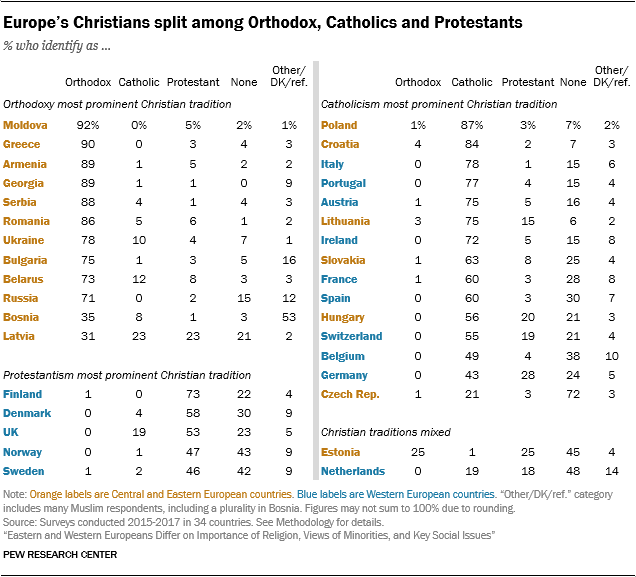
Orthodoxy, Catholicism and Protestantism are each prominent in dissimilar parts of Europe
Christianity has long been the prevailing faith in Europe, and it remains the majority religious affiliation in 27 of the 34 countries surveyed. Merely historical schisms underlie this common religious identity: Each of the three major Christian traditions – Catholicism, Protestantism and Orthodoxy – predominates in a certain part of the continent.
Orthodoxy is the dominant faith in the East, including in Greece, Russia, the former Soviet republics of Moldova, Armenia, Georgia, Ukraine and Belarus, and other sometime Eastern bloc countries such as Serbia, Romania and Bulgaria. Catholic-majority countries are prevalent in the central and southwestern parts of Europe, cut a swath from Republic of lithuania through Poland, Slovakia and Hungary, and and so extending westward beyond Croatia, Austria, Italy and France to the Iberian Peninsula. And Protestantism is the dominant Christian tradition in much of Northern Europe, particularly Scandinavia.
There are substantial populations belonging to non-Christian religions – particularly Islam – in many European countries. In Bosnia, roughly half of the population is Muslim, while Russian federation and Republic of bulgaria have sizable Muslim minority populations. But in most other countries surveyed, Muslims and Jews make upward relatively pocket-sized shares of the population, and surveys oft are not able to reliably mensurate their precise size.
In add-on, all the Western European countries surveyed take sizable populations of religiously unaffiliated people – those who identify as atheist, agnostic or "nothing in item," collectively sometimes called "nones." "Nones" brand upwardly at least 15% of the population in every Western European country surveyed, and they are particularly numerous in the netherlands (48%), Kingdom of norway (43%) and Sweden (42%). On residue, in that location are smaller shares of "nones" – and larger shares of Christians – in Central and Eastern Europe, though a plurality of Estonians (45%) are unaffiliated, and the Czechia is the only country surveyed on the unabridged continent where "nones" form a majority (72%).
Christian affiliation has declined in Western Europe
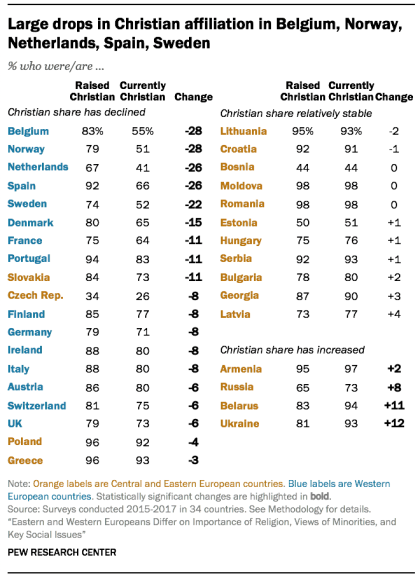 The lower Christian shares in Western Europe reverberate how the region's religious landscape has been irresolute within the lifetimes of survey respondents.
While large majorities beyond the continent say they were baptized Christian, and most European countries even so accept solid Christian majorities, the survey responses indicate a significant decline in Christian affiliation throughout Western Europe. By contrast, this trend has not been seen in Fundamental and Eastern Europe, where Christian shares of the population have mostly been stable or even increasing.
Indeed, in a office of the region where communist regimes once repressed religious worship, Christian amalgamation has shown a resurgence in some countries since the fall of the USSR in 1991. In Ukraine, for example, more people say they are Christian now (93%) than say they were raised Christian (81%); the same is true in Russia, Republic of belarus and Armenia. In most other parts of Central and Eastern Europe, Christian shares of the population have been relatively stable by this mensurate.
Meanwhile, far fewer Western Europeans say they are currently Christian than say they were raised Christian. In Belgium, for example, 55% of respondents currently identify as Christian, compared with 83% saying they were raised Christian.
What are the reasons for these opposing patterns on different sides of the continent? Some appear to exist political: In Russia and Ukraine, the most common caption given by those who were raised without a faith but are now Orthodox is that religion has become more adequate in society. Some other of import reason is a connexion with their national heritage.
In Western Europe, in that location are a variety of reasons why many adults who were raised Christian accept get unaffiliated. Near of these adults say they "gradually drifted away from religion," though many also say they disagreed with church positions on social issues like homosexuality and abortion, and/or that they stopped believing in religious teachings.
Religious commitment particularly depression in Western Europe
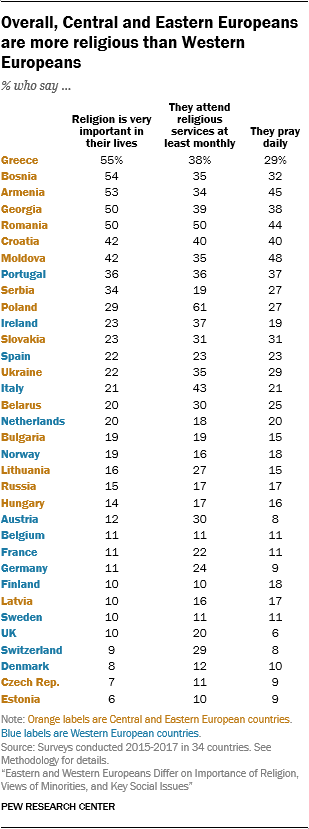 Non only is religious affiliation on the decline in Western Europe, religious commitment also is more often than not lower in that location than in Central and Eastern Europe.
This is not to say that Primal and Eastern Europeans are very religious by conventional measures of religious beliefs. Europeans throughout the continent generally show far less religious delivery than adults previously surveyed in other regions.eight
That said, on balance, Cardinal and Eastern Europeans are more than likely than Western Europeans to say that faith is very important in their lives, that they attend religious services at least monthly, and that they pray every day.
For example, fully half or more of adults in Greece, Bosnia, Armenia, Georgia and Romania say religion is very important in their lives, compared with about one-in-ten in France, Frg, the Uk and several other Western European countries. Similarly, roughly three-in-x Slovaks, Greeks and Ukrainians say they pray daily, compared with viii% in Austria and Switzerland. Western Europeans also are more than likely than their neighbors in the East to say they never pray (eastward.grand., 62% in Denmark vs. 28% in Russia).
Substantial shares in Western Europe don't believe in God
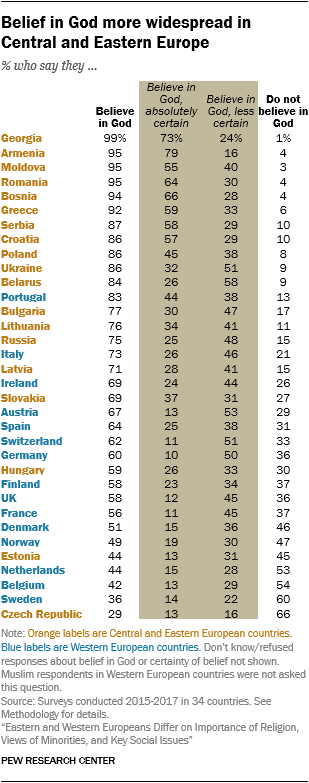 Western Europeans too express belief in God at lower levels than people in Central and Eastern Europe, where large majorities say they believe in God – including overwhelming shares in several countries, such as Georgia, Armenia, Moldova and Romania. Among the Key and Eastern European countries surveyed, there are only three exceptions where fewer than two-thirds of adults say they believe in God: Hungary (59%), Estonia (44%) and the Czech Republic (29%).
By dissimilarity, fewer than ii-thirds of adults in almost Western European countries surveyed say they believe in God, and in some countries with large populations of "nones," such as the Netherlands, Belgium and Sweden, fewer than one-half of adults believe in God.
Western Europeans too are less likely to say they are sure of their belief in God. Among the Western European countries surveyed, only in Portugal (44%) exercise more than three-in-ten say they are absolutely certain that God exists. Merely majorities in several of the Key and Eastern European countries surveyed express such certainty about God'south existence, including in Romania (64%), Hellenic republic (59%) and Croatia (57%).
Majorities in about Cardinal and Eastern European countries believe in fate
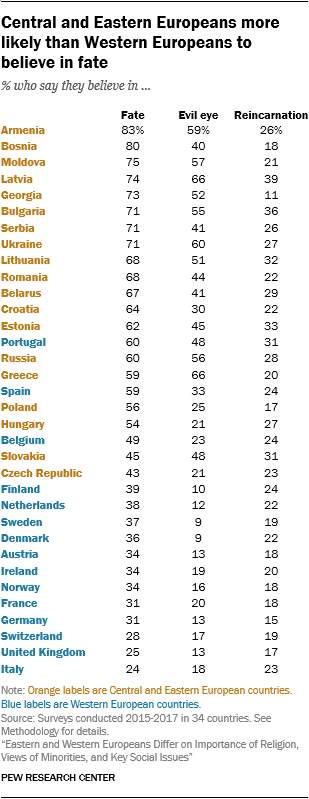 In addition to belief in God, Central and Eastern Europeans are more likely than Western Europeans to express belief in fate (that the course of life is largely or wholly preordained), besides as in some phenomena non typically linked with Christianity, including the "evil eye" (that certain people can cast curses or spells that cause bad things to happen to someone).
Majorities in nigh Central and Eastern European countries surveyed say they believe in fate, including about 8-in-ten in Armenia (83%) and Bosnia (eighty%). In Western Europe, far fewer people believe their lives are preordained – roughly four-in-ten or fewer in most of the countries surveyed.
Belief in the evil eye is also common in Central and Eastern Europe. This belief is almost widespread in Hellenic republic (66%), Latvia (66%), Ukraine (threescore%), Armenia (59%), Moldova (57%), Russian federation (56%) and Bulgaria (55%).
In fact, the levels of conventionalities in the evil eye across Primal and Eastern Europe are comparable to those found in Latin America and sub-Saharan Africa, where indigenous religions have had a wide impact on the respective cultures. (Run into "Religion in Latin America: Widespread Alter in a Historically Cosmic Region" and "Tolerance and Tension: Islam and Christianity in Sub-Saharan Africa.") In Western Europe, on the other hand, in no state does a majority limited belief in the evil eye.
Levels of belief in reincarnation are more comparable beyond the region. In about Fundamental and Eastern European countries surveyed, a quarter or more than say they believe in reincarnation – that is, that people will exist reborn in this world once more and again. In many Western European countries surveyed, roughly one-5th of the population expresses conventionalities in reincarnation, a concept more closely associated with Eastern religions such as Hinduism and Buddhism than with Christianity.
Prevailing view beyond Europe is that faith and regime should be separate
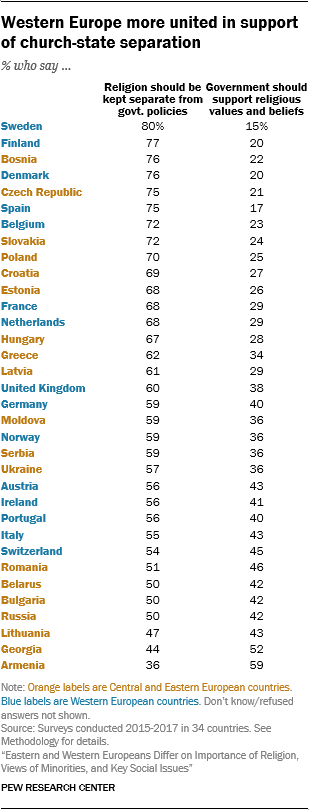 Europeans across the continent are largely united in support of a separation betwixt religion and government. More one-half of adults in almost countries say faith should be kept separate from government policies, rather than the opposing view that government policies should back up religious values and behavior.
In seven Cardinal and Eastern European countries, however, the view that church and land should be dissever falls short of a majority position. This includes Armenia and Georgia – where the residue of opinion favors government support for religious values and beliefs – as well as Russia, where 42% of adults say the government should promote religion.
In Western Europe, meanwhile, majorities in nearly every country surveyed say religion should be kept separate from government policies.
Age differences are stronger in Western Europe than in Eastern Europe on this issue: Younger adults beyond nigh of Western Europe are more likely than those ages 35 and older to prefer separation of church building and state. In Central and Eastern Europe, meanwhile, younger and older adults limited roughly similar views on this question.
Europe split on importance of beginnings to national identity, united on importance of speaking national language
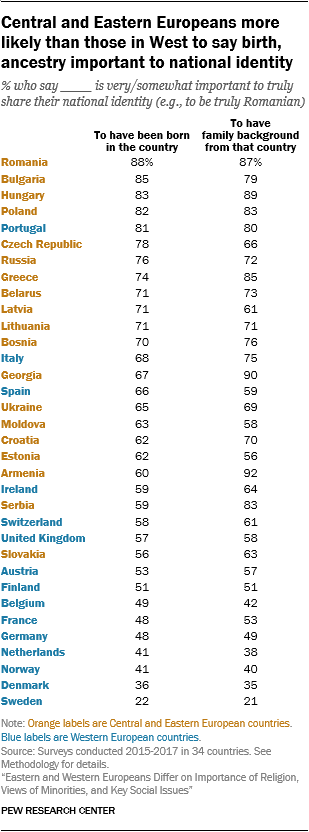 While majorities in near Primal and Eastern European countries tie beingness Christian to existence truly Serbian, Polish, etc. (encounter hither), majorities in all of these countries view being built-in in their country and having ancestry there equally important components of national identity.
For example, 83% of adults in Hungary and 82% of adults in Poland say information technology is "very" or "somewhat" important to have been born in their state to be "truly Hungarian" or "truly Polish." And 72% of Russians say it is important to have Russian family groundwork to be "truly Russian."
On residuum, adults in Western European countries are less probable to view these nativist elements equally important to national identity. For example, majorities in Sweden, Denmark, the Netherlands and Kingdom of norway say it is "non very" or "not at all" important to be born in their country or accept family unit background there to be "truly Swedish," etc.
But not everyone across Western Europe feels this style. In Portugal, for example, the vast majority of adults say that beingness born in Portugal (81%) and having a Portuguese family background (80%) are very or somewhat important to being "truly Portuguese." These sentiments also are widespread among adults in Italy and Spain.
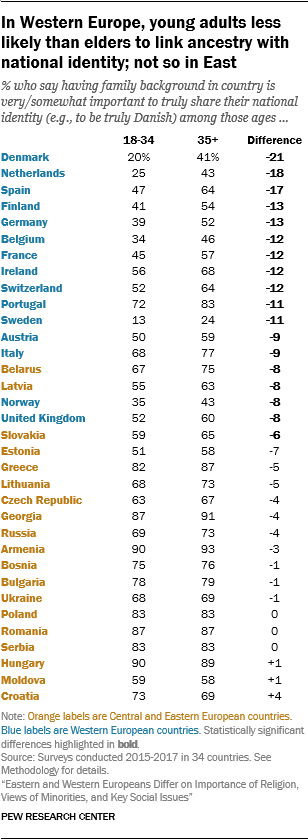 The two sides of Europe do not announced to be moving closer on these questions with younger generations. In fact, the opposite is true: In Western Europe, immature adults (ages eighteen to 34) are less likely than their elders to regard birthplace and beginnings equally crucial to national identity, while in Primal and Eastern Europe, young adults and older people are about equally likely to feel this way. In Spain, for example, but about one-half of adults under 35 (47%) say having Spanish beginnings is important to being Castilian, compared with 64% of older Spaniards. In Ukraine, meanwhile, young adults and older adults expect very similar on this question (68% vs. 69%).
Concerning the importance of family unit groundwork to national identity, in that location is a bigger gap between young adults in Western Europe and young adults in Central and Eastern Europe than between the adult populations as a whole.
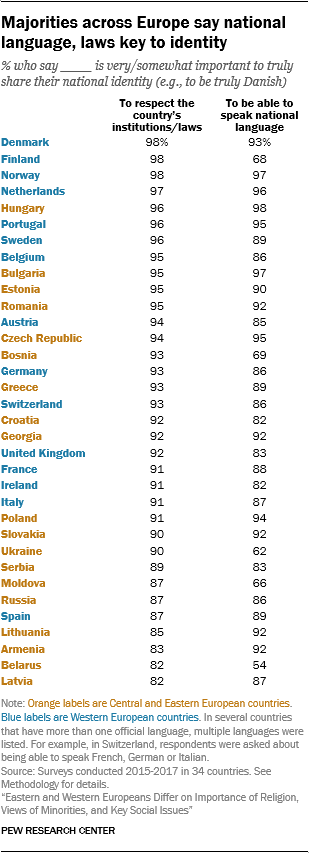 While public opinion on the importance of organized religion, birthplace and ancestry to national identity is different in Central and Eastern Europe than it is in the West, people throughout the continent largely hold on some other elements of national belonging. Adults in both regions say it is important to respect their country's institutions and laws and to be able to speak the national language to truly share their national identity.
In fact, overwhelming majorities of adults in every European land surveyed – East and West alike – say it is of import to respect the laws of their land in club to truly belong. For case, 98% of Danes, 96% of Hungarians and 87% of Russians say it is of import to respect their institutions and laws to truly be Danish, Hungarian or Russian.
And large shares in both Eastern and Western European countries say speaking the national language is of import to sharing their national identity. For example, in the Netherlands, 96% of adults say speaking Dutch is important for being truly Dutch. And in Georgia, 92% of adults say it is of import to speak Georgian to truly share their national identity. There are a few countries, however, where this sentiment is somewhat less mutual: But about two-thirds of adults in Moldova, Finland and Bosnia say speaking the national language is of import to truly belonging to their state, as do only 62% of Ukrainians and 54% of Belarusians. This may reflect the fact that multiple languages are spoken in these countries, including large numbers of Russian speakers in Moldova, Ukraine and Belarus.
Source: https://www.pewresearch.org/religion/2018/10/29/eastern-and-western-europeans-differ-on-importance-of-religion-views-of-minorities-and-key-social-issues/
Posted by: blazeradbital.blogspot.com
0 Response to "How Have Changes In Eastern Europe Altered The Enthic Makeup Of European. Countries Answers"
Post a Comment